You know that feeling. You pick something up in a shop, cheap and pretty and easy, and something in you quietly says no. You buy it anyway.
Later it sits unworn, or falls apart, or just feels wrong. We have all been there. In that second, you already knew what you were choosing.
Fashion makes that feeling easy to see. What we wear touches our skin all day, and it also comes from one of the largest, most complicated supply chains on Earth.
And right now, fashion has a truth problem. Words like “eco”, “green”, “conscious” and “sustainable” are everywhere, on hangtags, in campaigns, in every second product description. Too often, they are not proof of anything.
In a sweep by the European Commission, 53% of environmental claims examined were vague, misleading, or unfounded, and 40% had no supporting evidence at all. Around 92 million tonnes of textile waste end up in landfill every year, according to figures widely cited from the Ellen MacArthur Foundation, and less than 1% of the material used to make clothes is recycled into new clothes. No major brand has yet achieved full supply-chain traceability, according to the Fashion Transparency Index.
How to spot an empty claim
Greenwashing rarely looks like an outright lie. It looks like a beautiful half-truth. A vague word with no definition. A small “good” capsule inside a business still built on overproduction. A “natural” label on a garment that is mostly polyester, or a “recycled” label that covers only the packaging. An offset bought somewhere else, instead of producing less harm in the first place.
The test is simple: can the brand tell you, in plain language, what material it uses, where and how it is sourced, and what certificates it holds? And does its design give you an approximate idea of how long the piece will last, not just because it is durable, but because it is made to complement your wardrobe, not to clutter it with another fast trend? If not, the word on the label is decoration, not information.
Why I feel this personally
I work in this industry. I draw every print by hand, and we print those designs on natural fabrics. So I am inside the very system I am describing, and I feel that responsibility every day.
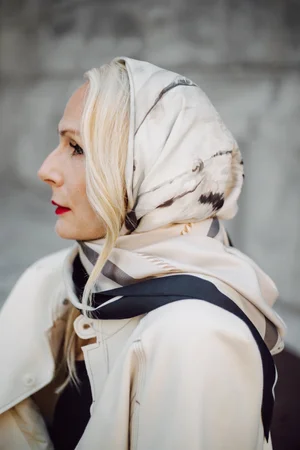
I will not pretend I have solved it. It is a hard balance: a better dye, a longer-lasting fabric, a design not made to be discarded next season. Every honest choice has a cost. What I can do is be specific. Each scarf is made from 100% natural fabric, all dyes used in printing are eco-certified, each design is scaled so less than 3% of the fabric remains unused, and a timeless design, cared for properly, can live for decades. For our ORCAS designs, 5% of sales goes to organisations that rescue whales entangled in fishing gear and marine debris. That is not everything. But it is specific, and specific can be checked.
Beyond fashion
The same pause works anywhere. In the grocery store, when tomatoes sit in a plastic container inside another plastic bag, and you choose the loose ones instead. When you refuse the extra bag, reuse the container, repair the coat instead of replacing it, or buy something once and wear it for ten years instead of buying five times and throwing them away.
None of this requires perfection, or becoming a different person overnight. It asks for one pause before you buy: do I need this, what is it made of, how long will it last, and what happens to it afterwards? Greenwashing wants you to feel good without thinking. A conscious choice is the opposite: think first, then feel good for a real reason.
What real luxury looks like now
Luxury used to mean more, newer, louder. For me now, it is simpler: knowing what you own, where it came from, and why you chose it.
So when a brand tells you it is sustainable, ask for the next sentence. A brand that welcomes that question is already rare. A brand that answers it plainly is one you can trust.
That is luxury now: to be yourself, and to leave the world a little cleaner and a little more truthful than you found it.